

Customized solutions for various crane types.
Rope inspection on container cranes is one of those demanding inspection tasks that require experience and technical understanding.
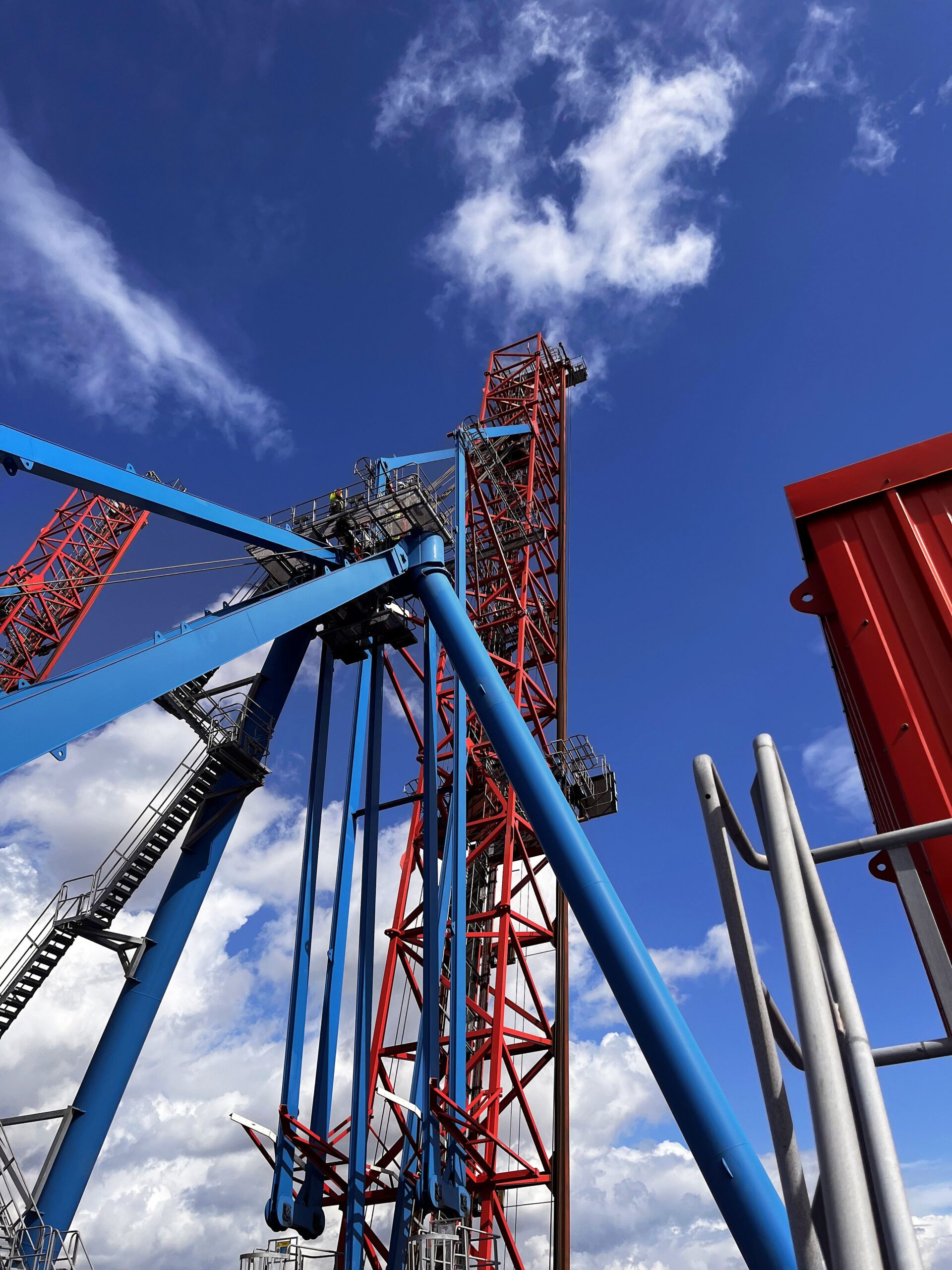
Our colleague Marcus Liebscher was once again on assignment at HHLA in the Port of Hamburg in September. At the Container Terminal Tollerort, he inspected the hoist ropes on several container cranes.
This presented a particular challenge: the cranes in use come from a total of four different manufacturers. Each crane has a slightly different design, thereby imposing its own specific requirements for inspection.
Four manufacturers, four different designs
Different crane types vary in terms of factors such as rope routing, installation conditions, and accessibility. Consequently, inspections cannot simply be carried out according to a standardized procedure.
“You always have to come up with something to properly inspect the areas,” says Marcus, describing the situation during such operations.
The design of the specific crane therefore also dictates how the inspection can be effectively carried out.
When the design dictates the test path
Especially with the cables of the retraction mechanisms, it is important to reliably access the relevant areas. To do this, one must first examine in detail how the cable is routed and integrated into the respective structure.
Only then can it be determined which approach is suitable for the examination.
For Marcus, this means adapting to each crane individually. What works for one design is not necessarily the right solution for another crane.
Technical experience is required.
When inspecting ropes on container cranes, therefore, the testing technology employed is not the only factor that matters; experience and technical understanding are equally important.
It is precisely when dealing with different crane manufacturers that the importance of combining technical knowledge with practical experience becomes evident. The existing design must be understood in order to reliably inspect the relevant sections of the rope.
Inspection directly at the container terminal
The work was carried out directly on the container cranes in use at the Tollerort terminal. The chosen approach had to be tailored to the specific equipment and its installation situation.
For Marcus Liebscher, working with various crane designs is part of his daily routine. Each job presents its own specific conditions and therefore requires a suitable solution.
It was precisely this experience that was required for this operation in Hamburg as well.
More than just modern testing technology
Reliable rope inspection results from the interplay of various factors. In addition to suitable inspection technology, technical understanding, experience, and a careful assessment of the specific system are crucial.
The deployment at HHLA clearly illustrates this. Four different crane manufacturers mean four different designs—and, consequently, different requirements for rope inspection on container cranes.
For ROTEC, professional rope inspection therefore means evaluating each system individually and developing the appropriate solution for the specific situation.
ROTEC – we make ropes safe.
Further information
▶ YouTube
Discover more videos about our rope testing systems, application examples, and innovations.
💼 LinkedIn
Follow ROTEC for current projects, new products, and insights into our development work.
Pictured: